

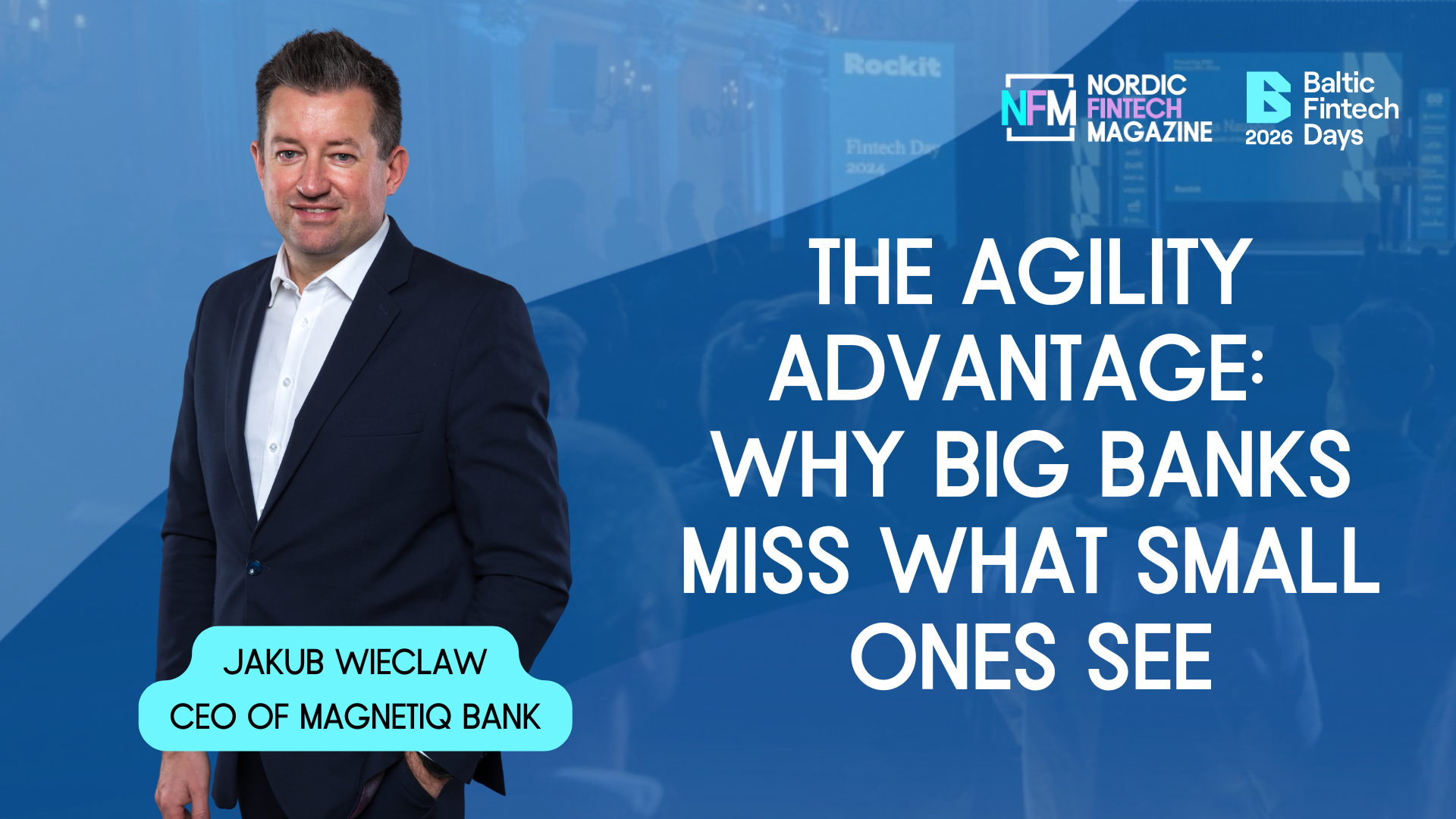
When Jakub Wieclaw took over as CEO of Magnetiq Bank in January 2025, he inherited a company at an inflection point.
The bank had pivoted away from being a universal financial institution chasing every customer to becoming something much more focused: a fintech-enabling bank. Not a bank that competes with fintech. A bank that powers them.
This wasn’t a retreat. It was clarity about where the real opportunity actually was.
In the Baltics, the traditional banking sector has two tiers. At the top sit the giants: banks with 50% market share each, operating with the momentum of decades. They’re comfortable. They’re profitable. But their approach is a bit too cautious, and as a result, they aren’t fully capturing the momentum of the emerging fintech space. They see fintech as retail banking or SME lending. That’s what they’re focused on.
Last chance: Get your tickets for Baltic Fintech Days May 13
This decision has left them out of the fastest-growing sector” They don’t see this as an opportunity for them,” Wieclaw told me. “The bigger banks, they feel very comfortable. But they’re not focused on the fintech area. They’re focused on retail banking, SME, small, medium and enterprises market. We have of course LHV, Citadele Banka, Rietumu Banka, Signet Bank, Magnetiq Bank on this landscape. They are also operating pretty well on the market. But they need to find the niche.”
There is a growing gap between traditional offerings and fintech needs; these companies have moved beyond the requirement for a simple bank account and now require deep infrastructure integration.
They need a license delivery partner. They need regulatory infrastructure. They need someone who can move fast and adapt when requirements change. They need what Magnetiq Bank became.
“And we see this opportunity and we started our marketing campaign on that sector that we are ready to support those fintechs and the growth,”
Jakub Wieclaw,
CEO of Magnetiq Bank

The shift wasn’t random. It was born from seeing a problem that nobody else wanted to solve. Small fintech companies were trying to enter the European market. They’d get a license in one country, then discover that the regulatory framework was different somewhere else. The compliance burden wasn’t just high, it was different everywhere.
But Wieclaw saw what the industry got wrong. Magnetiq Bank could pinpoint exactly what was broken in the fintech ecosystem, and more importantly, they could fix it.
The business model is elegant in its simplicity. Magnetiq Bank provides the banking infrastructure, the licensed entity, that allows fintech companies to operate across European markets. They’re B2B. They’re not touching end customers. Their clients are other fintech companies who need that regulatory passport to expand. It’s license as a service. It’s banking infrastructure abstracted from the traditional retail banking business.
Last chance: Get your tickets for Baltic Fintech Days May 13
And it’s working at a speed that would terrify the incumbents.
In 2025 alone, Magnetiq Bank attracted 95 new fintech clients. That’s 95 companies that decided the path to European expansion ran through Magnetiq Bank. They’ve expanded into five countries. They’re actively acquiring in the Baltics and Germany. A small bank from Latvia is now operational in the German market. Not because they’re competing on deposits or loan rates. Because they solved a problem that the giants decided was outside their primary focus..
“And we see this opportunity and we started our marketing campaign on that sector that we are ready to support those fintechs and the growth. Of course in some cases, you know, you have 10 fintechs and maybe eight will be successful or if you maybe they will be successful. This is always a challenge. That is why we are actively onboarding new clients and we are growing together some partners, we see how they are growing and also we could support this growth.”
This is the critical insight: Magnetiq Bank didn’t succeed because they’re smarter than the big banks. They succeeded because they’re small enough to see the problem and fast enough to solve it before anyone else noticed it existed.
Big banks have committees. They have approvals. They have frameworks designed for stability, not speed. If you need a decision with a corporate bank, Wieclaw explained it like this: “In big banks groups this is impossible. If you need to take a decision, you have a lot of approvals. You need organization nice committees. After three months, probably you will take the decision.”
At Magnetiq Bank, the decision-making process is different. “In our case, we are ready to take the decision faster. And this is also, I think, a key advantages on each market, we are maybe smarter or faster in the decision making process. Because everything is happening here and this is really convenient.”
That’s not just an operational advantage. That’s a structural one. And in fintech, structure determines who survives.
The real lesson here goes beyond Magnetiq Bank. It’s about what happens when an incumbent industry gets disrupted not by direct competition, but by someone solving a different problem entirely. The big banks weren’t worried about Magnetiq Bank. TBut while they were focused on defending their retail and SME franchises, Magnetiq Bank was building the infrastructure layer that would eventually power the entire next wave of European fintech.
Last chance: Get your tickets for Baltic Fintech Days May 13
In the fintech landscape, agility is a primary competitive advantage – a quality that established banking systems find challenging to balance alongside their immense scale. Due to their size and regulatory responsibilities, traditional institutions often prioritize stability, which can make it difficult to pivot as rapidly as the market evolves. Their existing business models, while robust, are built for a different era, making it a complex task to integrate the disruptive shifts we see today.
Magnetiq Bank saw the game had already changed. They just decided to play a different sport.
Magnetiq Bank recognized early on that the landscape had shifted and chose to pursue a distinct strategic path. While industry giants remain focused on maintaining their established ecosystems, emerging fintechs are already leveraging alternative partnerships that bypass traditional dependencies. By utilizing flexible licensing and agile frameworks, smaller players are building robust enterprises in spaces that were previously underserved.
This isn’t just disruption; it’s sound business – addressing real-world challenges at scale and with greater speed.
Magnetiq Bank was able to pinpoint a fundamental market gap that the rest of the industry is only beginning to address