


Being unable to access social media for 12 hours is inconvenient. However, that’s nothing compared to a bank going dark because one of the “Big Three” cloud providers has been hit by an “operational issue.”
Many companies recently woke up to what programmers call SPOF—a Single Point of Failure—when major cloud infrastructure providers went down, taking critical infrastructure like banks with them.
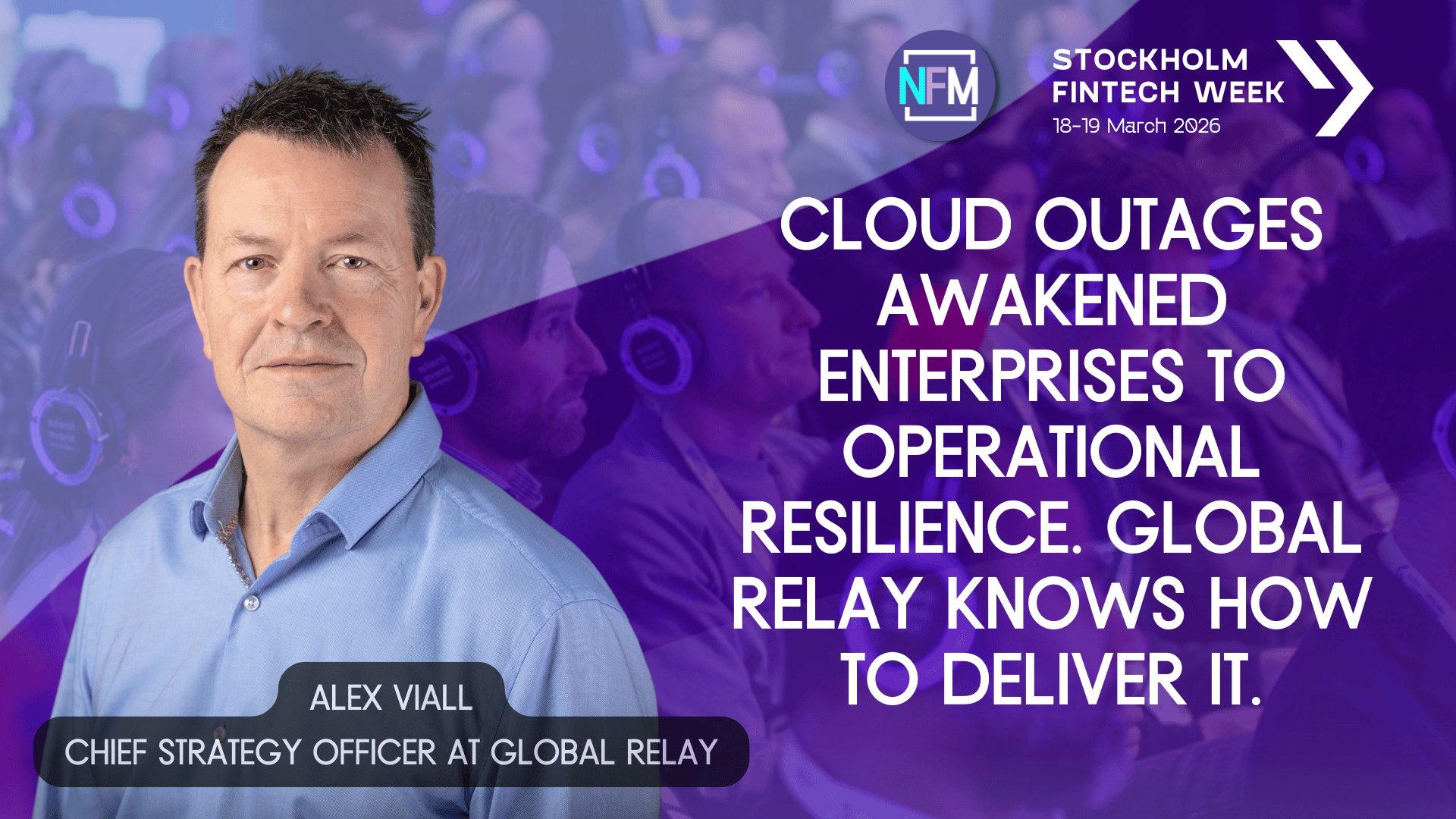
“One of our European banking customers told us this can never happen again, so they’re considering using Global Relay’s tried-and-tested private cloud infrastructure as a backup,” says Alex Viall, Chief Strategy Officer at Global Relay, the Canada-based firm that’s spent 25+ years innovating in the compliance, data storage, and communications monitoring space.
Global Relay‘s customers operate in highly regulated sectors and include some of Europe’s largest banks. The company secures customer data, enhancing their security and resilience, and ensuring compliance with regulatory frameworks.
“Security is the company’s mantra,” says Alex.
Last chance: Get your tickets for Stockholm Fintech Week March 19
Operational resilience is high on the regulatory agenda
DORA, the Digital Operational Resilience Act, stipulates that financial entities must be able to withstand, respond to, and recover from severe ICT (Information and Communication Technology) disruptions—such as a global cloud outage.
The potential points of failure in our increasingly connected world continue to grow. It isn’t enough to secure your own network – an organization is only as strong as its weakest link. Attacking that weakest link is known as a supply chain attack.
It was a supply chain attack that caused the notorious SolarWinds hack in 2020, affecting Fortune 500 companies, government offices, and critical infrastructure organizations. In the United States alone, companies affected by the attack lost an average of 14% of their annual revenue.
The only way to avoid such an attack is to work with a platform that provides end-to-end security, avoiding outsourcing to third parties that might have less effective network security.
“At Global Relay, we take data security very seriously,” says Alex. “We believe a private cloud, end-to-end platform is the most secure solution.”
Another potential operational resilience weak link is mobile communications. Agreements can be made through WhatsApp chats, text messages, and many other communication channels.
“We put data first. All
our operations revolve
around data—organizing
it, adding value to it,
storing it, and securing it.”
Alex Viall
Chief Strategy Officer at Global Relay

Global Relay’s solutions, including a proprietary app and a range of data connectors for multiple channels, have been developed to completely capture business communications data for compliant archiving to meet regulatory requirements.
Able to be used across both company and employee-owned devices, firms have access to the tools required to meet recordkeeping requirements and control off-channel communications risk. Through proactive communications monitoring, firms can identify the signs of money laundering, non-financial misconduct, and sensitive business information being leaked.
“We put data first. All our operations revolve around data—organizing it, adding value to it, storing it, and securing it,” says Alex.
Operational resilience has become table stakes to operate successfully in a modern world, and Global Relay makes it possible for companies to achieve that resilience – without having to build an entire internal team to do it.
Last chance: Get your tickets for Stockholm Fintech Week March 19